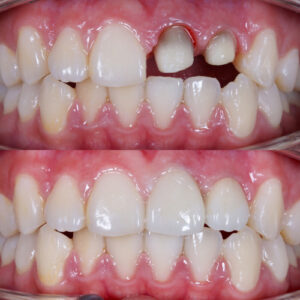
Most people take good care of their teeth and can rely on keeping them for a lifetime, but sometimes cavities or an injury results in the loss of a tooth. Because all teeth are important for eating, speaking and overall health, we at Dental Health Associates advise that missing teeth be replaced. Dental bridges and dental implants are two options we use for those who have lost a tooth and this article explains the difference between the two procedures.
Dental Implants
For those who would like a replacement that looks and feels much like a natural tooth, the dental implant is a great option. A dental implant is a prosthetic that is implanted into the bone of your jaw and then capped with a high quality crown that looks like a natural tooth. Dental implants often last longer than natural teeth as they are not prone to decay, although they can be damaged by injury.
Benefits of Dental Implants
Dental implants provide many advantages over traditional dentures. They are designed to look and feel like natural teeth, meaning they blend in with your existing teeth and can be cared for just like natural teeth.
Dental implants are small, titanium posts that mimic the root structure of natural teeth. Unlike removable dentures, they don’t require adhesives or special cleaning agents to stay firmly in place.
Who is a Good Candidate for Dental Implants?
Most people with missing teeth due to injury, disease, or other causes are good candidates for dental implants. However, you should consult with your dentist and periodontist to determine if you are an ideal candidate. Generally speaking, suitable candidates must have healthy gums and adequate bone in the jaw where the implant will be placed. If these conditions are not met, you may still be a candidate for an implant, but additional treatments or procedures may be necessary before implant placement.
The Process of Dental Implants
The dental implant process typically involves several visits to your dentist and periodontist over several months. First, your dentist will refer you to a periodontist, and from there, you will meet with them to discuss treatment plan options and determine the next steps.
If it has been determined that an implant is the best course of action, you will schedule your next visit. If your tooth hasn’t been removed or is still in place, your dentist or periodontist will extract the tooth.
During subsequent visits, your implant will be placed into the jawbone, and an abutment (which connects the implant to the replacement tooth or bridge) will be attached. After your implant has fully integrated with the bone and surrounding tissues, a crown or bridge will be added to restore your smile.
Dental implants require a minor surgery that allows the dentist to secure a metal shaft into the jawbone which will hold the crown. Your jawbone will regrow around the shaft to make it secure, much like the roots of a normal tooth. Once the crown is secured onto the shaft, you should not notice the implant at all.
Keeping Your Gums Healthy
Dental implants do have a unique advantage over other tooth replacement options. Because the implant is inserted into the bone of the jaw, it helps keep your gums healthy. By reducing bone loss, an implant also helps keep surrounding teeth healthy.
Insurance and Costs
The cost of dental implants will vary depending on several factors, including your case and how many teeth need to be replaced. Generally, a single implant can range from $4,000 to $6,500 per tooth, while multiple implants and crowns can cost up to $30,000. Be sure to speak with your periodontist or financial coordinator about the specific costs associated with your case.
Some insurance providers may cover a portion of the cost, while others may not offer any coverage at all. Before beginning treatment, we recommend you check with your insurance company about out-of-network coverage. Your financial coordinator at the periodontal office can also recommend financing options if needed.
Dental Bridges
Dental bridges are another option for those with a missing tooth. A dental bridge is a structure that bridges the gap by modifying other teeth to support a framework of crowns. This framework gives the appearance of a normal tooth being in place. A bridge can last several years and special care needs to be taken to keep it clean, along with the surrounding, natural teeth.
Dental bridges are custom-made prosthetic devices that are designed to fill the gaps left from missing teeth. They are constructed with two or more crowns, referred to as abutment teeth, which are placed beside the open area to secure the artificial teeth, known as pontics, in place. The result is a seamless and natural-looking restoration that enhances your appearance while also allowing you to chew and speak comfortably.
Replace Missing Teeth at a Lower Cost
When you decide to replace a missing tooth with a bridge, the dentist must examine the teeth surrounding the gap to make sure those teeth can support the bridge. A tooth that has large amounts of decay or cracks may not be suitable. Once the dentist is satisfied that the surrounding teeth are healthy, those teeth are then prepped for the process. Their crowns are ground down and impressions are made so that the bridge can be created in the lab. Temporary crowns are placed over the prepared teeth to protect them from further damage.
Once the lab has created the bridge, the dentist can then place the bridge in the patient’s mouth. To do so, the temporary crowns are removed and the prepped teeth are gently cleaned to remove the temporary cement. The bridge is placed on the teeth to ensure a proper fit. A bonding agent is applied to the crown and the bridge is secured. Bridges are a great, lower cost option for those with missing teeth. While it is not permanent, it should last many years.
Why Choose Dental Bridges?
- Restore Your Confidence: Our dental bridges are designed to match the color, shape, and size of your natural teeth, ensuring a seamless blend that enhances your smile and boosts your self-esteem.
- Improve Functionality: Dental bridges restore your ability to enjoy a diverse diet and speak clearly, allowing you to live your life without limitations.
- Maintain Oral Health: When a tooth is missing, adjacent teeth can shift, causing alignment issues. Dental bridges prevent this by filling the gap and keeping your remaining teeth properly aligned.
- Long-lasting Solution: With proper care and regular dental visits, dental bridges can last for many years, providing a durable and reliable tooth replacement option.
Our Approach to Dental Bridges
At Dental Health Associates of Madison, we understand that each patient has unique needs and concerns. Our team is committed to actively listening, explaining the procedure in detail, and answering questions. We will work closely with you to create a personalized treatment plan addressing your needs.
Experience the Difference at Dental Health Associates of Madison.
When you choose our practice for your dental implant or dental bridge treatment, you can expect the highest level of care and professionalism. We are dedicated to creating a comfortable, non-judgmental, and welcoming environment where your oral health is our top priority.
Visit Our Dental Clinic for a Consultation
If you have a missing tooth, please know that there are options to correct this. With help from the professional staff at DHA, you can choose the option that is best for you. Please let us know if you have any questions about these procedures or any of our other dental services.
Request an Appointment and take the first step towards regaining your confidence and enjoying all the benefits dental bridges offer.